Digital Watches for Everyday Wear: Which Features Matter
By Marcus Bellamy · Published · 5 min read
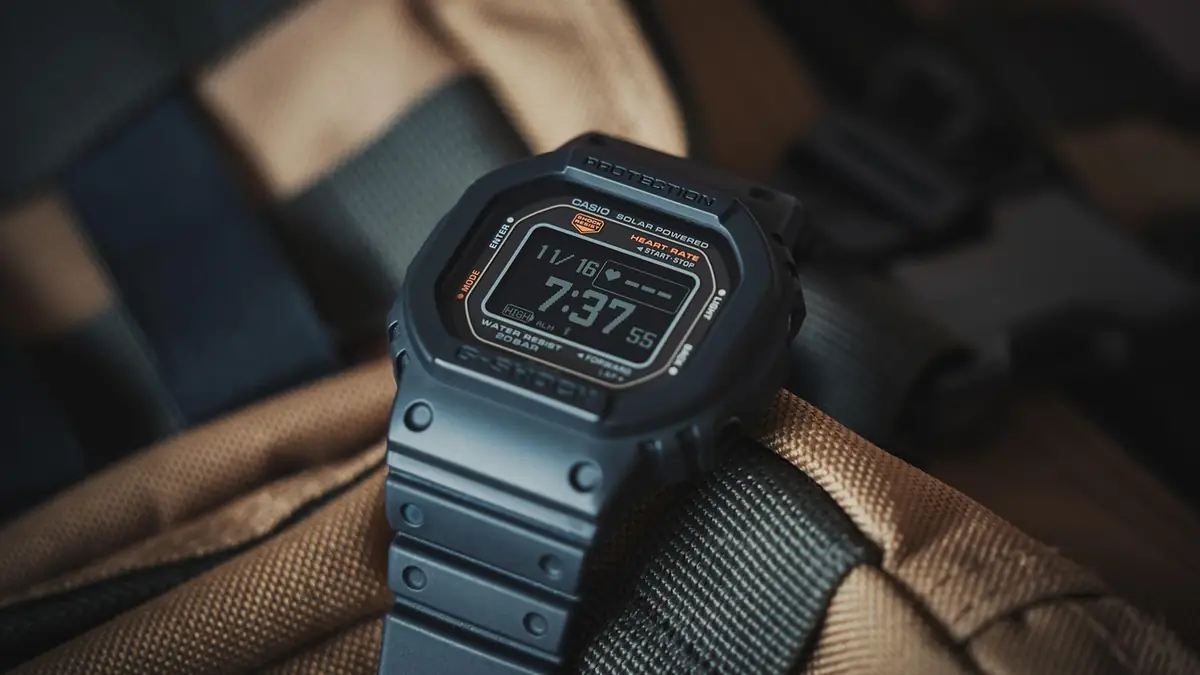
Digital watches get sold on spec sheets, and most of those specs never come up on a Tuesday morning. What actually matters is whether you can read the time in a dark car park, whether the watch survives a shower and a beach trip, and whether you're hunting for a charger every third day.
This guide ranks features by how often they earn their keep in normal life, with the numbers you should be looking for. Prices sit mostly between roughly $30 and $250 for solid everyday digital watches; above that you're paying for materials, sensors or branding rather than better timekeeping.
Start With Readability, Not the Spec Sheet
A digital watch exists to tell the time at a glance, and legibility is where cheap models usually fail. Look for a display with clear segment separation and contrast you can read at arm's length without squinting. Negative displays (light digits on a dark background) look sharp in photos but are noticeably harder to read in bright sun and at low light on budget models.
Digit height matters more than screen size. On a typical 40-44 mm case, you want the main time digits to occupy roughly the top third of the display, with seconds and date smaller. Try before you buy if you can: hold the watch at arm's length in the shop and check you can read it without your glasses if you wear them.
Viewing angle is the other quiet factor. Twisted-nematic LCDs wash out when you tilt your wrist, which matters when you're driving or holding a kettle. A basic monochrome LCD with a decent polariser will beat a fancy colour screen for everyday legibility almost every time.
- Main digits readable at arm's length, no squinting
- Positive (dark-on-light) display for daylight clarity
- Check the viewing angle by tilting the watch
- Avoid tiny sub-dials crammed into a 38 mm case
Backlight and Night Use
If you're going to use one feature daily, it's the light. An LED backlight or electroluminescent panel costs almost nothing to add and transforms the watch after dark. Most decent models offer a button-press light lasting 1-3 seconds, and better ones add an auto-light or tilt sensor that triggers when you turn your wrist.
Two things to check. First, whether the light illuminates the whole display or just one corner; partial lighting is common on very cheap watches and looks worse than none. Second, whether the light is bright enough to read without dazzling you at 3 a.m. A soft green or amber glow is easier on the eyes than harsh white.
Battery cost is the trade-off. Frequent backlight use can shorten coin-cell life by a noticeable margin, though on a typical 3-5 year cell it's rarely the deciding factor. If you use the light constantly, a rechargeable model starts to make more sense.
Water Resistance: Read the Rating, Not the Marketing
Everyday water resistance is the feature people underestimate until their watch fogs up. Ratings are tested under static pressure, so what you can actually do is narrower than the number suggests. A 30 m (3 ATM) rating means splash resistance only: handwashing is fine, swimming is not. 50 m (5 ATM) covers showers and brief surface swimming for most people.
For regular swimming, pool laps and beach holidays, 100 m (10 ATM) is the sensible floor, and 200 m (20 ATM) if you dive or surf. Buttons that can be pressed underwater are a bonus; on many digital watches the pushers are sealed and safe to use, but check the manual rather than assuming.
Two practical rules. Never press buttons on a watch rated below 100 m while it's wet, and have the caseback gasket checked every few years, especially if you swim. A $60 watch with a perished gasket leaks just as badly as an expensive one. If you pair a digital with smarter pieces, the same logic applies to how you treat a black and gold watch around water and heat.
Battery Life and Charging Reality
Battery life splits into two camps. Standard coin-cell or button-cell models typically run 2-10 years on a cell that costs a few dollars to replace, with no charging routine at all. Rechargeable smart-ish hybrids run anywhere from 5 days to 30 days per charge depending on screen use, notifications and GPS.
The honest question is whether you want another device to charge. A 10-year battery watch is genuinely set-and-forget; a 7-day rechargeable means a weekly ritual and a cable in your bag. For most people wearing a watch purely for time, date and an alarm, a long-life cell wins on convenience and total cost of ownership.
If you do go rechargeable, check the charging connector: pogo-pin proprietary cables are easy to lose and expensive to replace, while USB-C is a real advantage for travel. Solar charging is a nice supplement but rarely enough on its own in winter or with heavy backlight use.
- 2-10 years: standard cell, near-zero maintenance
- 5-30 days: rechargeable, needs a routine
- Check the cable type before buying rechargeable
- Solar helps but rarely replaces charging entirely
Alarms, Timers and the Functions You'll Actually Press
Most people use three functions: time, date and a countdown timer. A daily alarm is useful if you're not relying on a phone, and a second time zone helps if you travel or work across time zones. Beyond that, the value drops fast. Stopwatch splits, lap memory and tide graphs are fine, but be honest about whether you'll ever press those buttons.
Timer usability is underrated. You want a timer you can set in a few presses, not one buried three menus deep. On many digital watches, the fastest path is a dedicated button or a long-press shortcut; check reviews or the manual before buying. A timer that takes 12 button presses won't get used.
Multiple alarms, hourly chimes and countdown repeat functions are cheap to include and occasionally handy. World time with 30+ cities is mostly a spec-sheet flex, but a simple dual-time display is genuinely useful if you call family overseas. If you're layering the watch with other accessories, keep the kit simple and functional, much like the approach in this beard grooming kit checklist.
| Feature | What to look for | Typical cost impact | Use frequency |
|---|---|---|---|
| Backlight | Full-display LED or EL, 1-3 s press | Included on most models | Daily |
| Water resistance | 100 m (10 ATM) minimum for swimming | Modest; steep above 200 m | Several times a week |
| Battery life | 5-10 year cell or 2-4 week rechargeable | $0-20 cell swap vs. charging routine | Constant |
| Timer and alarm | Few-press access, dedicated button | Included on most models | Several times a week |
| Display legibility | Positive LCD, large main digits | No premium needed | Every time you look |
| Strap and weight | Quick-release, resin or steel, under ~70 g | $10-20 for a spare strap | All day |
| Sensors and colour screens | Only if you'll use them | Adds $50-150+ | Rarely |
Case, Strap and Fit for Daily Wear
Digital watches live or die on comfort. Case sizes of roughly 38-44 mm suit most wrists; anything over 46 mm starts to look and feel like a brick, especially with resin straps that don't flex. Lug-to-lug length matters more than diameter: if it overhangs your wrist, it will catch on sleeves and feel clumsy.
Resin and polyurethane straps are cheap, light and swim-friendly, but they can trap sweat and crack after a few years. Steel bracelets add weight and cost but last longer and dress up better. Quick-release spring bars are worth paying a little extra for, since they let you swap straps without tools. A spare 20 mm or 22 mm NATO strap costs $10-20 and changes the look entirely.
Weight is the sleeper spec. A 45-60 g resin watch disappears on the wrist; a 120 g steel model reminds you it's there. For all-day wear, under about 70 g is a comfortable target, and it matters more than a millimetre of case diameter either way.
Where to Spend and Where to Save
Spend on the case, the crystal and the water resistance, because those decide how long the watch lasts. Mineral glass scratches within a year or two of daily wear; sapphire or hardened glass is worth the premium if it's offered. Stainless steel casebacks outlast plated brass, which pits and flakes with sweat and salt water.
Save on sensors, colour screens and app connectivity unless you'll genuinely use them. A $40-80 digital watch with 100 m water resistance, a good backlight and a 5-10 year battery covers almost everything an everyday wearer needs. The jump to $150-250 buys better materials and finishing, not better timekeeping; quartz accuracy of roughly ±15-30 seconds a month is standard at every price.
If you're building a small collection, it helps to know what different tiers deliver, whether that's digital or mechanical; the same logic runs through this guide to automatic watches under $300.
- Prioritise a full-display backlight, 100 m water resistance and a battery you don't have to think about.
- Positive LCDs with large main digits beat colour screens for daily legibility.
- Spend on case material, crystal and sealing; save on sensors and app features.
- Keep the watch under about 70 g and 46 mm for comfortable all-day wear.
Marcus has spent years testing grooming tools, watches and everyday menswear and writing up what actually holds up to daily use. He focuses on value, fit and the small practical details buyers only notice after a few weeks. He edits every recommendation guide on the site.